
The result of over 50 years of quality workmanship.
Each shoreline is unique and we encourage you to check out our photo gallery below to see how we can profile your dock or lakeside deck around your landscaping to give it that custom finish.
We take pride in our ability to serve our customers on an individual basis. From custom design, through manufacturing and installation, our priority is your complete satisfaction and confidence that an R&J Machine product is the best there is. With an R&J Machine product your valued property will be protected, providing you with years of enjoyment and satisfaction.
Choosing the right dock system is one of the most important decisions for any waterfront property owner. The two most common options – pipe docks and floating docks – each offer unique advantages depending on your shoreline, water conditions, and how you plan to use your dock. Understanding the differences can save you time, money, and frustration over the long term.
What is a Pipe Dock?
A pipe dock (also known as a stationary dock) is supported by adjustable legs that rest on the lakebed. The frame is typically aluminum, making it strong, lightweight, and resistant to corrosion.
- Stable and solid feel – Minimal movement underfoot
- Ideal for shallow water – Best suited for consistent depths
- Lower cost – Generally more affordable than floating systems
- Seasonal removal friendly – Easy to take out in fall and reinstall in spring
- Gradual, firm shorelines
- Water depths typically under 6–8 feet
- Areas with minimal water level fluctuation
- Cottage owners who prefer a traditional, rigid dock feel
- Not suitable for deep water
- Can be difficult on soft or muddy lakebeds
- Requires manual leveling and adjustment
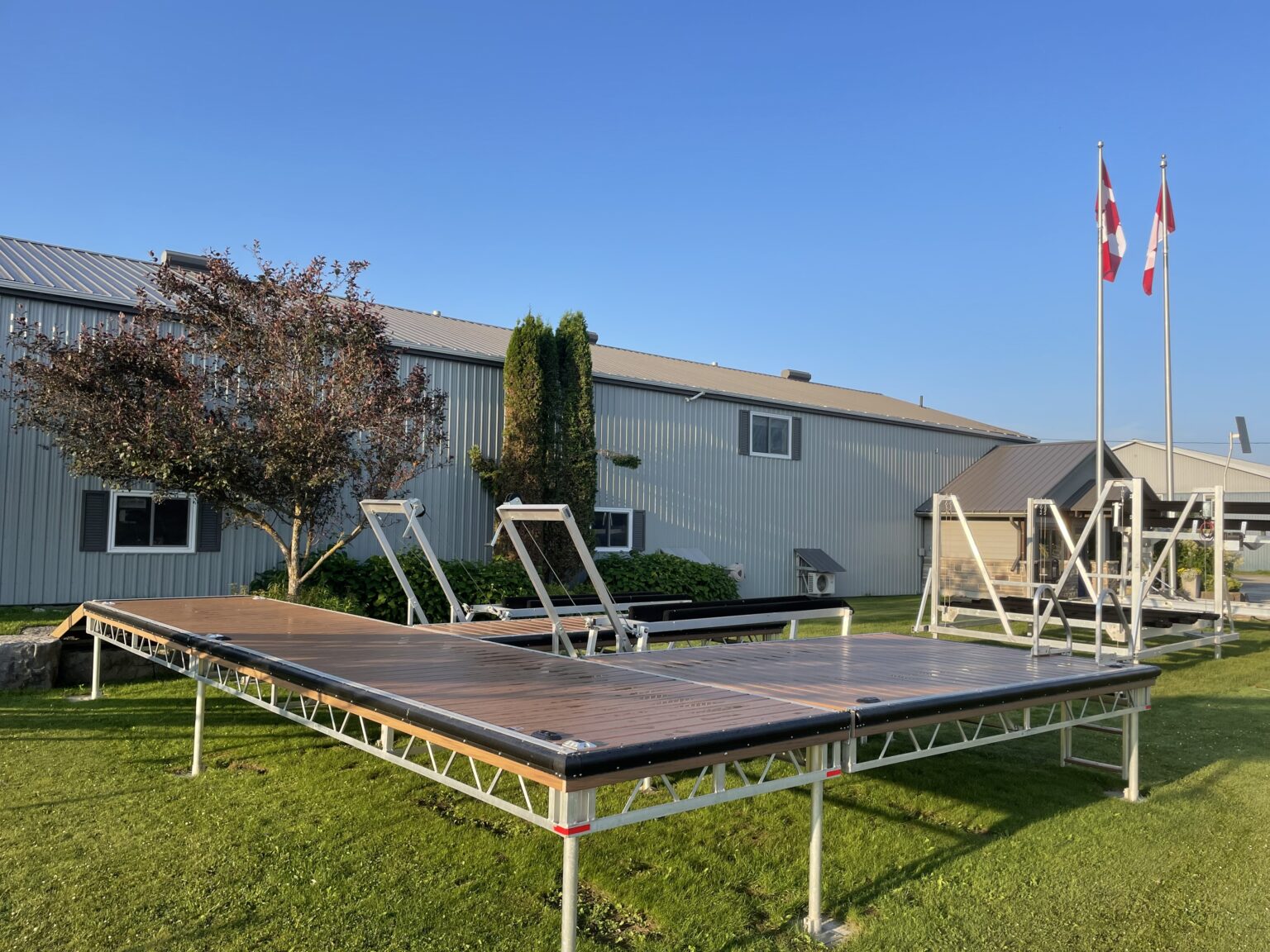
Lift-Up Pipe Truss Docks: A Premium Pipe Dock Option?
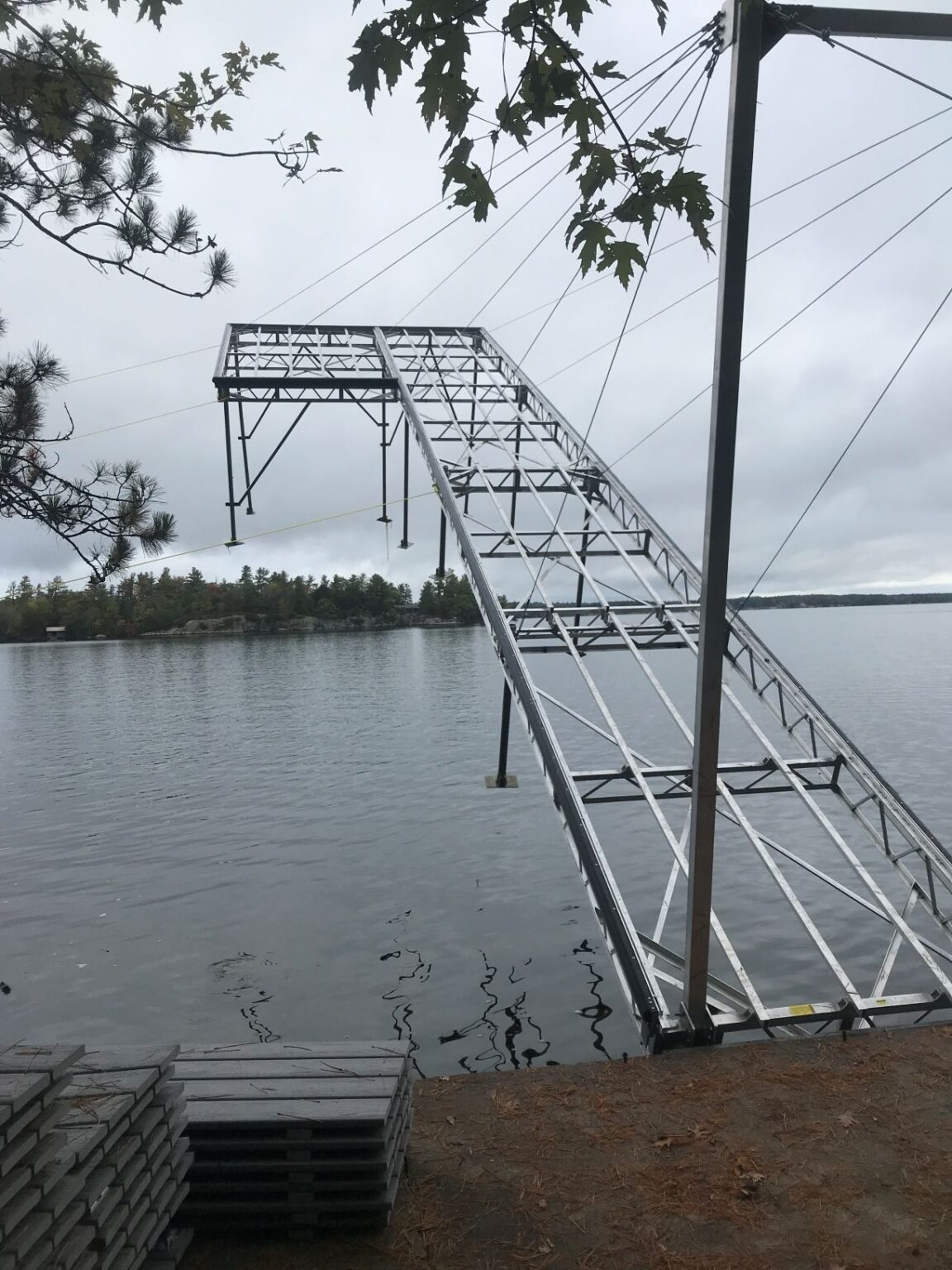
A lift-up pipe truss dock is an advanced version of a traditional pipe dock, built with a reinforced truss frame and typically equipped with a wheel or winch system. This allows the entire dock to be winched up out of the water for seasonal removal.
- Extremely strong and rigid – Truss design adds superior structural strength
- Easier seasonal removal – winch the dock out without full disassembly
- Handles longer spans – Ideal for reaching deeper water while maintaining stability
- Reduced annual setup time – Less lifting and adjustment compared to standard pipe docks
- Properties where ease of seasonal removal is a priority
- Cottage owners who want a more heavy-duty, long-term dock system
- Locations without significant ice buildup at the shoreline (important—these systems need to be hinged to the shoreline)
If your shoreline experiences ice piling or rolling ice, a lift-up system may not be ideal. In those cases, a removable sectional pipe dock or floating dock is often a better choice.
What Is a Floating Dock?
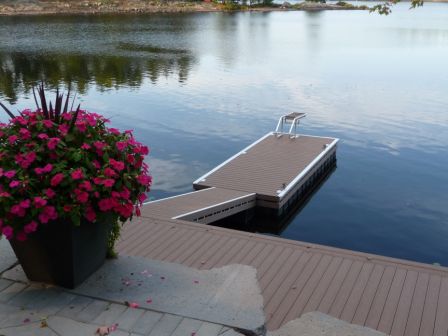
A floating dock sits on top of the water using buoyant floats (usually polyethylene). It rises and falls with changing water levels, making it highly versatile.
- Adapts to water level changes – Always stays at the same height relative to the water
- Great for deeper water – No need to reach the lakebed
- Handles soft or uneven bottoms – No levelling required
- Modular design – Easy to expand or reconfigure
- More movement underfoot compared to pipe docks
- Typically higher upfront cost
- Requires proper anchoring in rough water conditions
- Deep water or steep drop-offs
- Lakes with significant seasonal water fluctuation
- Soft, muddy, or rocky lakebeds
Marinas or high-traffic boating areas
Key Differences at a Glance
| Feature | Pipe Dock | Floating Dock |
| Water Depth | Shallow | Deep or variable |
| Stability | Very stable | Slight movement |
| Water Level Changes | Needs adjustment | Self-adjusting |
| Installation | Manual setup | Anchored in place |
| Cost | Lower | Higher |
| Lake Bottom Required | Yes | No |
Which Dock Should You Choose
There’s no one-size-fits-all answer—it depends entirely on your waterfront.
- If your shoreline is shallow, firm, and consistent, a pipe dock is often the most cost-effective and comfortable solution.
- If your property has deep water, fluctuating levels, or a soft bottom, a floating dock will provide better long-term performance and convenience.
Final Thoughts
The right dock system should match your environment—not fight against it. Investing in the correct style from the start will improve usability, reduce maintenance, and extend the life of your dock.
If you’re unsure which option fits your property best, working with an experienced dock builder can help you evaluate your shoreline and make the right choice.
Need Help Choosing?
At R&J Machine, we design and build dock systems tailored to Canadian waterfront conditions. Whether you need a rugged pipe dock or a fully modular floating system, we can help you find the right fit for your property.
Complete our Request for Quote Form at the bottom of this page and a member of our sales team will be in touch to discuss the best docking option for your shoreline.